NYCU · MICROFLUIDICS & BIOSENSING

百洑傳息Bioflumen
& Xensor Lab

張鈞豪博士Dr. Chun-Hao Chang · Assistant Professor

從微尺度流動,
解讀生命訊息。

Decoding life’s messages through micro-scale flows.

國立陽明交通大學 · 醫學生物技術暨檢驗學系National Yang Ming Chiao Tung University
Department of Biotechnology and Laboratory Science in Medicine
01 微流體Microfluidics02 生物感測Biosensing03 體外診斷In vitro diagnosticsTAIPEI, TAIWAN ↗

EXPLORE · TOUCH · DISCOVER

從一滴檢體,走到一筆訊號。Follow the journey from sample to signal.

初次認識微流體?Start with the basics ↗

點選下方步驟,探索晶片上的檢測流程。Choose a step to explore the workflow.

檢體到訊號的流程概念圖兩個入口匯入彎曲微流道,連接感測區與訊號讀取模組。圖形用於概念解說,未呈現量測數據。 SAMPLEMICROFLUIDICSSENSINGREADOUT

先決定:我們要從哪一種檢體找答案?

依研究目的選擇汗液、呼氣冷凝液或其他檢體,規劃採集方式、樣本量與前處理需求。

Choose sweat, exhaled breath condensate or another specimen, then plan collection, sample volume and preparation around the research question.
用微流道安排液體與細胞的路徑。

以流道幾何與流動控制安排輸送、混合或分離,讓檢體在指定位置與試劑接觸;實際設計依檢測任務而定。

Channel geometry and flow control organize transport, mixing or separation, bringing the sample and reagents together where needed.

讓目標反應轉成感測器讀得到的變化。

結合生物辨識與訊號轉換,觀察目標造成的電化學或光學變化。圖中的電極是感測方式的概念例子。

Biological recognition and signal transduction connect the target to an electrochemical or optical change. The illustrated electrodes are one conceptual example.

把訊號變成可以檢查與比較的資料。

讀取訊號後,進行校正、對照與效能驗證,評估它能回答哪些研究問題。圖中曲線僅示意讀值流程。

Readout is followed by calibration, controls and performance validation to assess which questions the data can answer. The curve is illustrative.

流程概念示意;圖形與動畫未呈現實際裝置尺寸、流速或量測數據。Conceptual workflow; geometry, motion and signals do not represent measured results.

01 / ABOUT THE LAB

微尺度的流動,跨領域的訊息。Flow, life and signals.

「百洑傳息(Bioflumen & Xensor)」是一個以微流體與生物感測為核心的跨領域研究團隊。我們的核心理念融合了流體科學、生命科學與訊號科技,致力於從微尺度的流動中解讀生命訊息。
“Bioflumen & Xensor” is an interdisciplinary research team centered on microfluidics and biosensing. Our core philosophy integrates fluid science, life science and signal technology, dedicating our efforts to decoding life’s messages from micro-scale flows.

BIO + FLUMEN

百洑 Bioflumen

「百洑」源於流體中的多重洑流與渦流,代表我們在微晶片中創造並精準控制多樣化的流動結構,促進生化反應與分子交互作用。英文 Bioflumen 由 Bio(生命)與 Flumen(拉丁文的河川)組成,亦與百洑諧音,寓意微流體宛如生命之河,在晶片中承載並轉化細胞與分子的生化資訊。
“百洑” (Bai-fu) originates from undercurrents and vortices: diverse flow structures controlled within microchips to facilitate biochemical reactions and molecular interactions. Bioflumen combines “Bio” (life) and “Flumen” (Latin for river), symbolizing microfluidics as a river of life that carries and transforms the biochemical information of cells and molecules.

CROSS-DISCIPLINARY + SENSOR

傳息 Xensor

「傳息」代表我們將微觀的生物反應,轉化為可解析的宏觀數據。透過微流體與感測技術的整合,偵測、放大並傳遞生化訊號。英文 Xensor 將 Sensor 的首字母替換為 X,象徵跨領域(Cross-disciplinary)的協作與對未知(X)的探索,捕捉多重可能的生物訊號。
“傳息” (Chuan-xi) expresses our mission to translate microscopic biological reactions into interpretable data. Integrating microfluidics with sensing enables biochemical signals to be detected, amplified and transmitted. Xensor replaces the “S” in Sensor with an “X”, representing cross-disciplinary collaboration and exploration of the unknown.
在微流體的「流」之中孕育反應,在感測技術的「傳」之中解析訊息,讓生命訊號得以被看見與理解,並轉化為實質的科學與應用價值。
We nurture reactions within microfluidic flows and decode messages through sensing. Our aim is to make life signals visible and comprehensible, translating them into scientific and applied value.

RESEARCH APPROACH

從檢驗流程,走向診斷系統。From laboratory workflows to diagnostic systems.

我們將生醫微流體與半導體/微奈米製程導入醫學檢驗流程,發展體外診斷(IVD)與可攜式檢測系統。採檢、前處理、加樣反應、讀值與品管等醫檢知識,構成設計檢驗系統的起點。
We integrate biomedical microfluidics and semiconductor / micro–nano fabrication into medical laboratory workflows to develop in vitro diagnostic (IVD) and portable testing systems. Sampling, pretreatment, reactions, readout and quality control provide the starting point for system design.
研究概念示意 · AI-rendered research concept
從臨床需求與檢驗痛點出發,我們將檢體前處理、分離濃縮、反應與偵測等步驟以微流體重新設計,並結合微奈米製程。研究主題涵蓋核酸與免疫檢測整合、樣本處理模組化、生物感測與訊號讀取,以及兼顧臨床轉譯的系統驗證。
Starting from clinical needs and laboratory bottlenecks, we redesign specimen pretreatment, separation and enrichment, reaction and detection using microfluidics and micro/nanofabrication. Topics include integrated nucleic-acid and immunoassay testing, modular sample handling, biosensing, signal readout and system-level validation with translational considerations.
完整研發鏈涵蓋「檢驗需求 → 系統設計 → 製作與整合 → 效能驗證」,並把流程可行性、操作可靠度、干擾與可用性評估納入研究設計。
Our development pipeline spans diagnostic needs, system design, fabrication and integration, and performance validation. Workflow feasibility, operational reliability, interference and usability are considered in the research design.
  1. 01
    檢驗需求Clinical needs
  2. 02
    系統設計System design
  3. 03
    製作與整合Fabrication & integration
  4. 04
    效能驗證Performance validation
研發流程概念圖 · AI-rendered development concept · 點圖放大 / Select to enlarge

02 / RESEARCH STORIES

研究成果與技術路徑Research stories & technology

以下四項研究由主持人於實驗室成立前參與完成。圖文呈現各研究的設計、流程與驗證方式,作為本實驗室研究方向與技術背景的介紹。
The following four studies were completed with the PI’s participation before this lab was established. Their designs, workflows and validation methods introduce the technical background informing our research directions.

01 / WEARABLE SAMPLING

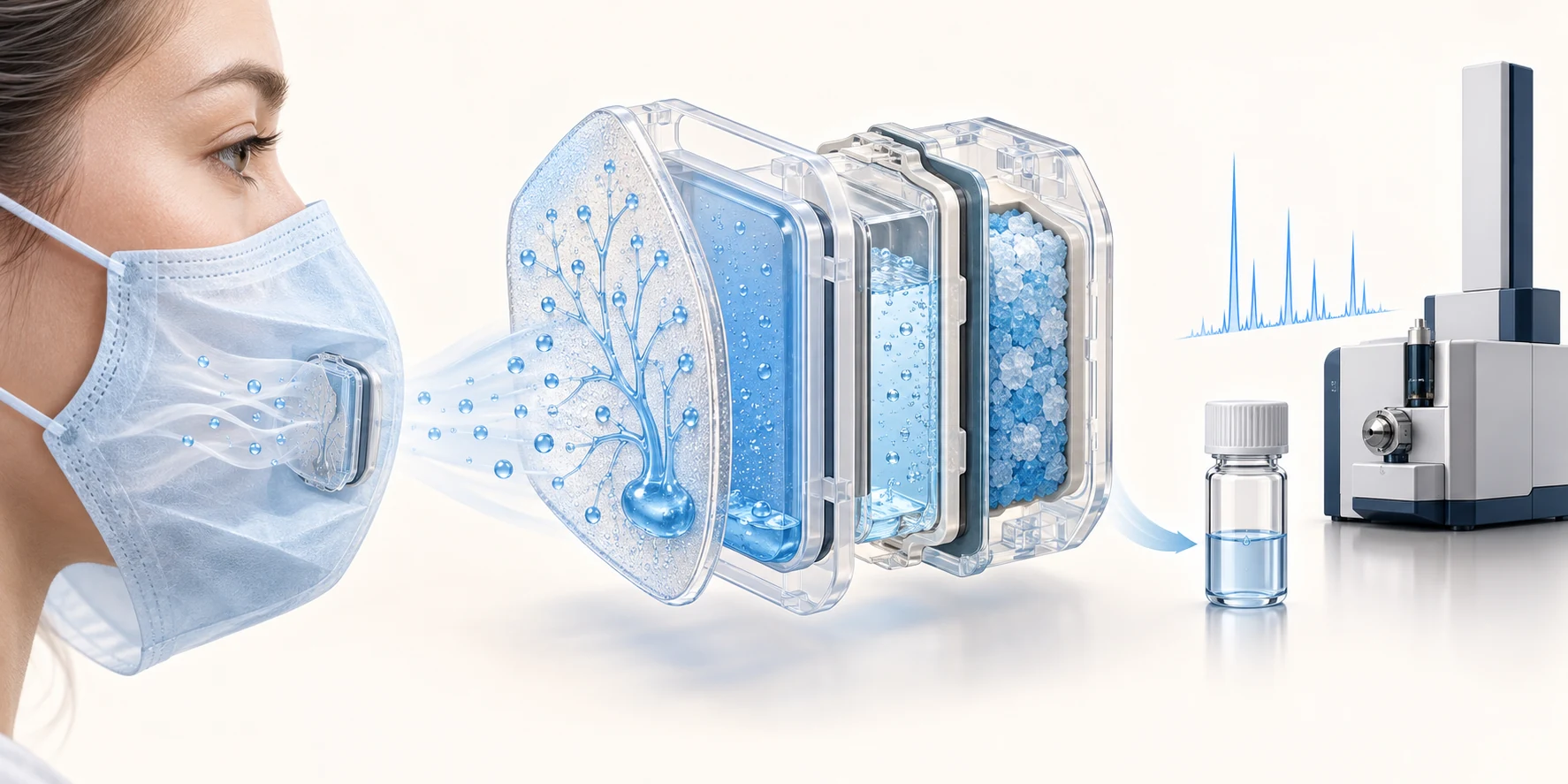
把呼氣,收集成可分析的液滴A wearable collector for exhaled breath condensate

Chemical Engineering Journal · 499, 155994

口罩整合、冷凝微流體與分枝親水結構。Mask integration, condensation microfluidics and branched hydrophilic structures.原論文 Fig. 1 裁切 · Cropped from Fig. 1 · DOI ↗
呼氣冷凝液(EBC)提供呼吸道檢體與代謝物分析的途徑。這項研究將吸熱反應微流體與分枝狀仿生親水薄膜整合於口罩中:微流體控制水與硝酸銨接觸,產生降溫;薄膜引導冷凝液流向採集區,再以液相層析質譜(LC–MS)分析咖啡因與尼古丁。
Exhaled breath condensate (EBC) offers a route to respiratory sampling and metabolite analysis. This work integrates endothermic microfluidics and a branched biomimetic hydrophilic film into a mask. Controlled contact between water and ammonium nitrate cools the collector; the patterned film guides condensate to the collection area. Collected samples were analyzed for caffeine and nicotine using liquid chromatography–mass spectrometry (LC–MS).
2.5 min人體呼氣採集時間Human sampling time
2 ± 1 μL人體測試的 EBC 採集量EBC collected in human tests
LC–MS咖啡因/尼古丁分析Caffeine / nicotine analysis

研究重點 Research contribution

研究連結微流體反應控制、表面潤濕設計與檢體採集。論文以人體採集及代謝物分析展示方法可行性,採集模組由吸熱反應提供冷卻。
The study connects microfluidic reaction control, surface wetting and specimen collection. Human sampling and metabolite analysis demonstrate feasibility, with an endothermic reaction supplying cooling to the collection module.
閱讀原論文 Read the paper ↗
  1. 01
    呼氣採樣Exhaled breath
  2. 02
    吸熱冷凝Endothermic cooling
  3. 03
    分枝薄膜集液Film-guided collection
  4. 04
    代謝物分析Metabolite analysis
研究概念示意 · AI-rendered research concept · 點圖放大 / Select to enlarge

02 / SAMPLE PRETREATMENT

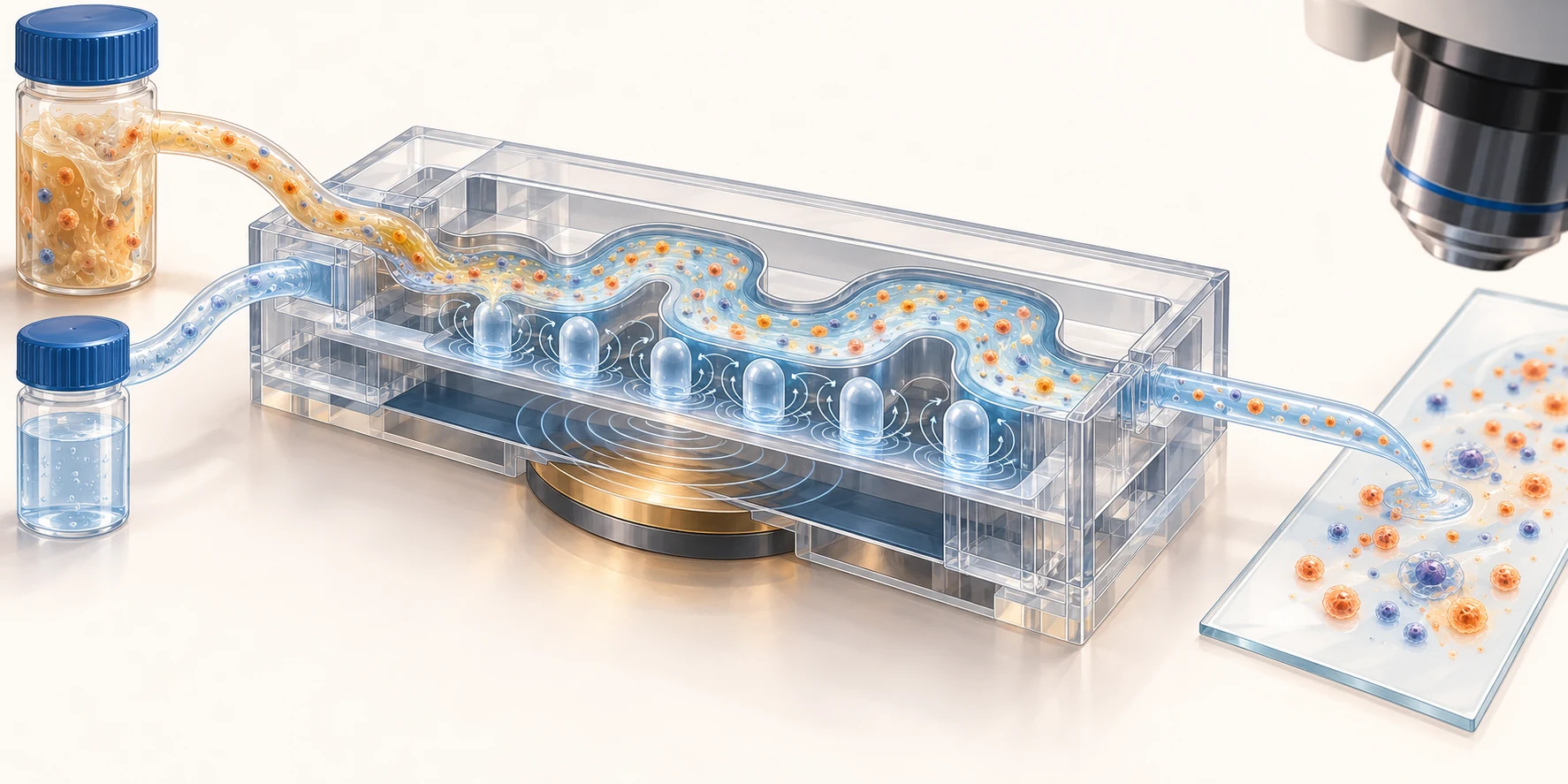
以聲學微流體處理黏稠痰液Acoustic microstreaming for sputum liquefaction

Sensors and Actuators B: Chemical · 394, 134356

垂直氣泡液化器、聲學混合測試與自動控制系統。Vertical bubble liquefier, acoustic mixing tests and automated control system.原論文 Fig. 1 裁切 · Cropped from Fig. 1 · DOI ↗
痰液的高黏度會影響混合、轉移與細胞濃縮。研究在微流道中配置垂直氣泡陣列,以聲波激發氣泡產生微流,混合痰液與液化試劑;再整合液體輸送、聲波驅動與微控制器,完成自動化處理。液化後的檢體用於細胞濃縮與抹片觀察。
High sputum viscosity complicates mixing, transfer and cell concentration. This study places vertical bubble arrays in a microchannel and drives the bubbles acoustically to create microstreaming that mixes sputum with liquefaction reagents. Liquid transport, acoustic actuation and a microcontroller were integrated into an automated system. Processed specimens were used for cell concentration and smear evaluation.
Bubble array垂直氣泡混合結構Vertical bubble mixing array
Automated輸送與聲波控制整合Integrated flow and acoustic control
Cytology液化後細胞抹片評估Post-liquefaction smear evaluation

研究重點 Research contribution

研究針對臨床檢體前處理設計封閉式混合模組,並以黏液模型及真實痰液測試液化與抹片表現。實驗結果呈現的是檢體處理與細胞觀察效能,臨床診斷效益仍需相應的臨床驗證。
A closed mixing module addresses a clinical specimen-preparation step. Mucin models and real sputum were used to evaluate liquefaction and smear performance. The reported evidence concerns specimen processing and cellular observation; clinical diagnostic benefit requires corresponding clinical validation.
閱讀原論文 Read the paper ↗
  1. 01
    痰液與試劑Specimen & reagent
  2. 02
    聲學氣泡混合Acoustic bubble mixing
  3. 03
    液化與細胞濃縮Liquefaction & concentration
  4. 04
    抹片觀察Cytology
研究概念示意 · AI-rendered research concept · 點圖放大 / Select to enlarge

03 / ON-SITE BIOSENSING

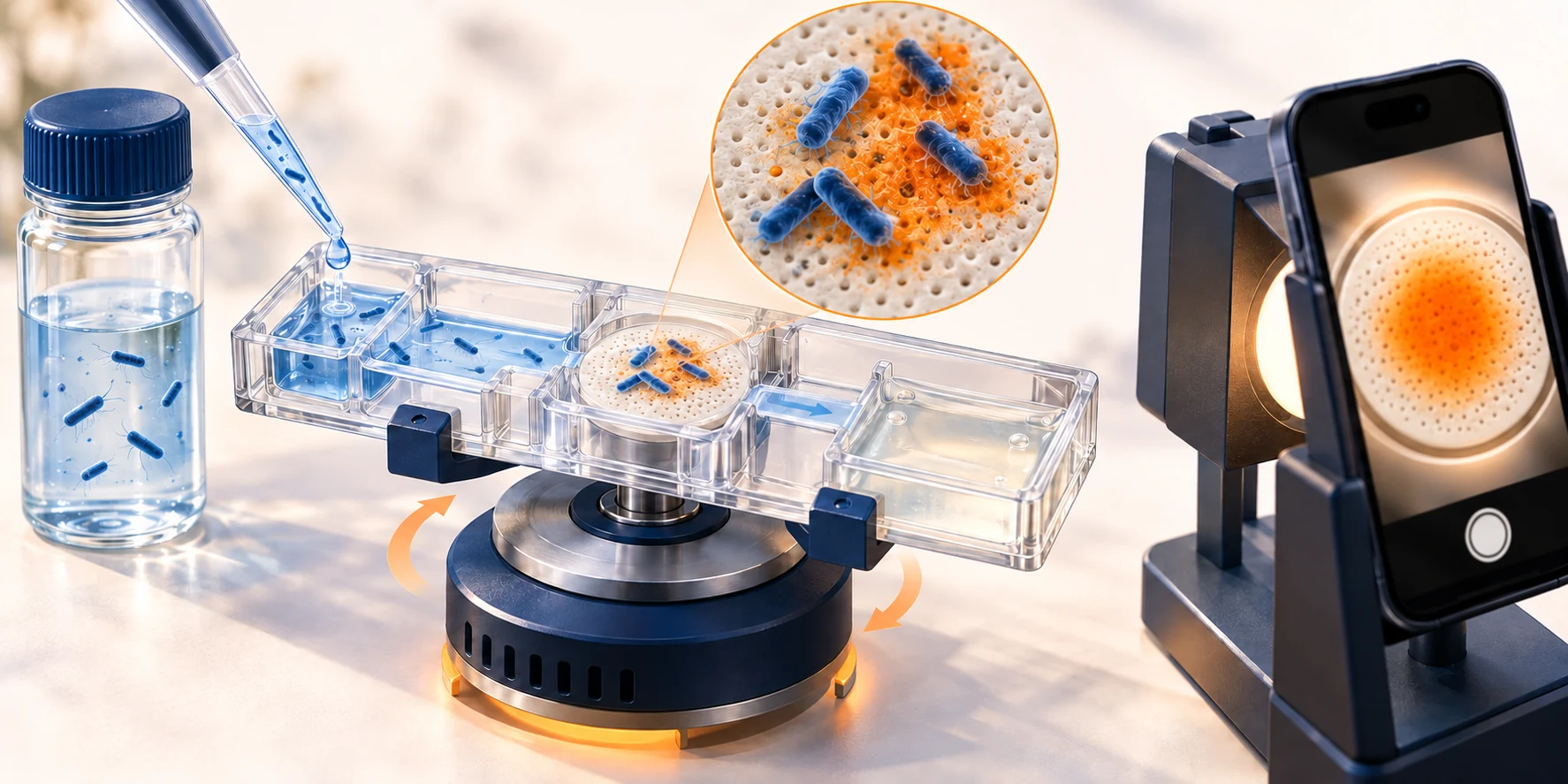
在濾膜上讀取水中的活菌訊號Membrane-integrated centrifugal detection of live bacteria

Biosensors and Bioelectronics · 236, 115403

晶片製作、濾膜結構、活菌比色機制與現場操作裝置。Chip fabrication, membrane structure, viability colorimetry and on-site equipment.原論文 Fig. 1 裁切 · Cropped from Fig. 1 · DOI ↗
研究將尼龍濾膜嵌入離心微流體晶片,利用旋轉將水樣中的細菌集中於濾膜。活菌的代謝反應使 WST-8 生成橙色 formazan,訊號留在濾膜上,以目視或手機影像讀取。手持風扇提供旋轉驅動,充電式暖手器提供反應所需熱源,形成定點檢測平台。
A nylon membrane is integrated into a centrifugal microfluidic chip to concentrate bacteria from water. Viable-cell metabolism converts WST-8 into orange formazan, which is retained on the membrane for visual or smartphone readout. A handheld fan drives centrifugation and a rechargeable hand warmer provides the reaction heat source, forming an on-site testing platform.
>500×論文報告的濃縮倍數Reported concentration factor
3 h論文報告的檢測流程時間Reported assay duration
10² CFU/mLE. coli 測試的檢測極限Detection limit in E. coli tests

研究重點 Research contribution

研究把濾膜濃縮、細胞代謝比色與離心操作整合在同一晶片。論文以大腸桿菌建立檢測範圍,並以校園水樣和 LB 平板、3M Petrifilm 菌落計數結果進行比較。
The chip integrates membrane concentration, metabolic colorimetry and centrifugal handling. E. coli was used to establish the detection range, and campus water samples were evaluated against colony counts from LB agar plates and 3M Petrifilm.
閱讀原論文 Read the paper ↗
  1. 01
    水樣加入Water sampling
  2. 02
    離心濾膜濃縮Membrane concentration
  3. 03
    活菌代謝顯色Metabolic color formation
  4. 04
    影像讀取Image readout
研究概念示意 · AI-rendered research concept · 點圖放大 / Select to enlarge

04 / MATERIALS & FABRICATION

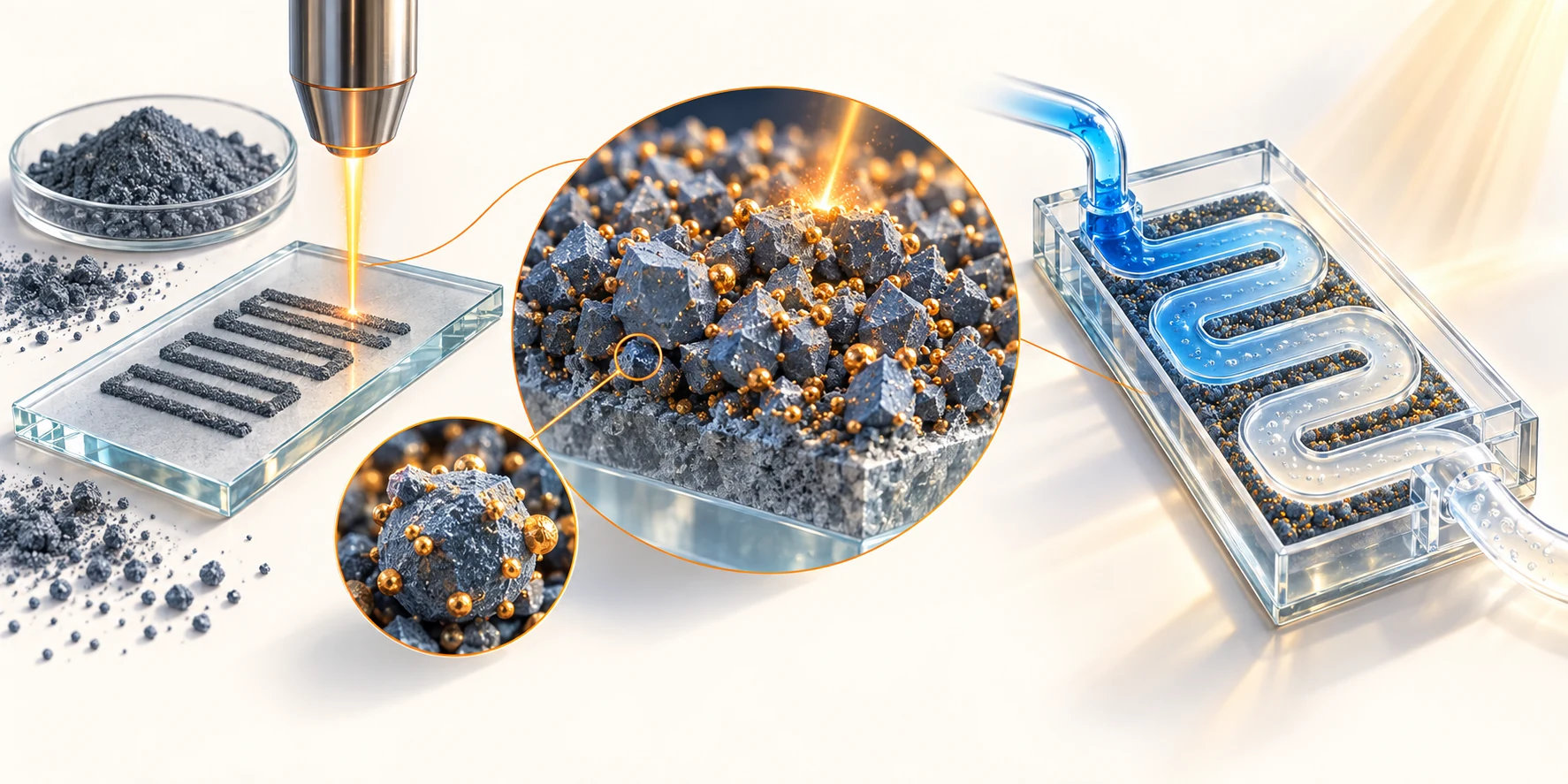
從回收 SiC 到光催化微流體Laser-fabricated Au/SiC photocatalytic microfluidics

ACS Sustainable Chemistry & Engineering · 12, 4486–4496

SiC 回收來源、光催化板製程與微流體反應器。Reclaimed SiC sources, photocatalytic plate fabrication and the microfluidic reactor.原論文 Fig. 1 裁切 · Cropped from Fig. 1 · DOI ↗
研究利用半導體製程的 SiC 回收粉末,以雷射熔覆固定於玻璃,再透過鍍金與雷射退火形成奈米金/SiC 光催化板。金奈米結構的局域表面電漿共振參與可見光下的電荷轉移;將材料整合入微流道後,以亞甲藍溶液作為模型污染物評估光催化降解。
Reclaimed SiC powder from semiconductor processing is laser-cladded onto glass, followed by gold deposition and laser annealing to form a nanogold/SiC photocatalytic plate. Localized surface plasmon resonance in the gold nanostructures contributes to charge transfer under visible light. Integration into microchannels was evaluated using methylene blue as a model pollutant.
30 min論文報告的材料製備時間Reported plate fabrication time
Au / SiC奈米金與碳化矽複合材料Nanogold / silicon carbide
Methylene blue光催化測試模型污染物Model pollutant for testing

研究重點 Research contribution

研究連結半導體副產物再利用、雷射製程與微流體反應器。材料製備與模型污染物測試提供光催化系統的研究依據。
The work connects reuse of semiconductor byproducts, laser processing and microfluidic reactors. Material fabrication and model-pollutant experiments provide evidence for the photocatalytic system.
閱讀原論文 Read the paper ↗
  1. 01
    回收 SiCReclaimed SiC
  2. 02
    雷射製程Laser fabrication
  3. 03
    奈米金修飾Gold nanostructures
  4. 04
    微流體光催化Microfluidic photocatalysis
研究概念示意 · AI-rendered research concept · 點圖放大 / Select to enlarge

03 / PRINCIPAL INVESTIGATOR

主持人Principal investigator

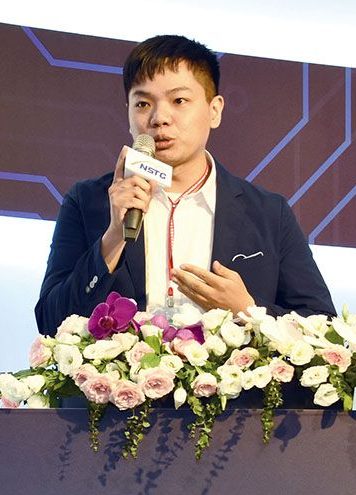
張鈞豪助理教授發表演講

CHUN-HAO CHANG, Ph.D.

張鈞豪

助理教授 Assistant Professor

jimhao@nycu.edu.tw ↗
我的研究主軸聚焦於將可落地的工程技術導入醫學檢驗與體外診斷(IVD)應用。我的專長涵蓋生醫微流體(microfluidics)、生物感測器(biosensors)與微陣列(microarray)等複合技術,並強調從「臨床需求/檢驗流程」出發,完成從元件設計、製程製作、系統整合到效能驗證的完整研發鏈。
My research focuses on translating deployable engineering technologies into medical laboratory workflows and in vitro diagnostics (IVD). My expertise spans integrated platforms combining biomedical microfluidics, biosensors and microarrays, with an end-to-end development pipeline—from identifying clinical needs and redesigning assay workflows to device design, fabrication, system integration and performance validation.
我的訓練包含醫學檢驗、工程研究與生物晶片產業研發,具備醫事檢驗師資格。研究中重視檢體處理、流程設計、結果判讀與可用性評估,也將工程量產與醫材法規的核心概念納入系統規劃,目標是發展具有自動化、臨床轉譯與產品化潛力的診斷平台。
My training combines medical laboratory science, engineering research and biochip R&D in industry, supported by a Medical Laboratory Scientist license. I bring a laboratory integration perspective covering sample handling, workflow design, result interpretation and usability assessment. Engineering-scale production and medical-device regulatory fundamentals also inform the design of platforms intended for automation, clinical translation and product development.
系上教師介紹與原始履歷 Official faculty profile ↗

學歷 Education

2021.02–2024.09
國立陽明交通大學 電機學院|電機工程學系(生醫組)博士
Ph.D. in Electrical Engineering (Biomedical Engineering Program), College of Electrical and Computer Engineering, National Yang Ming Chiao Tung University
2015.08–2017.08
國立交通大學 電機學院|生醫工程研究所 碩士
M.S. in Biomedical Engineering, College of Electrical and Computer Engineering, National Chiao Tung University
2011.09–2015.07
長庚大學 醫學院|醫學生物技術暨檢驗學系 學士
B.S. in Medical Biotechnology and Laboratory Science, College of Medicine, Chang Gung University

經歷 Professional experience

2026.02–
國立陽明交通大學 醫學生物技術暨檢驗學系 助理教授
Assistant Professor, Department of Biotechnology and Laboratory Science in Medicine, National Yang Ming Chiao Tung University
2024.10–2026.01
國立陽明交通大學 智慧醫電工程研究所 博士後研究員
Postdoctoral Researcher, Institute of Intelligent Biomedical Engineering, National Yang Ming Chiao Tung University
2017.11–2021.02
生捷科技股份有限公司 生物晶片研發工程師
Biochip R&D Engineer, Centrillion Technology
2015.10
林口長庚醫院實習;取得醫事檢驗師國考證照
Clinical internship at Linkou Chang Gung Memorial Hospital; Medical Laboratory Scientist national licensure
榮譽獎項 Honors & awards
2025.10
方賢齊 BioICT 博士論文研究獎|國立陽明交通大學
Xian-Qi Fang BioICT Ph.D. Research Thesis Award, National Yang Ming Chiao Tung University
2025.03
台灣化學會年會|台灣神隆分析化學論文獎首獎
ScinoPharm Analytical Chemistry Thesis Award — Outstanding, Chemistry National Meeting, Taiwan Chemical Society
2024.06
國立陽明交通大學 電機學院優秀畢業生獎;研究表現前 10%
Outstanding Graduate Award, College of Electrical Engineering, NYCU; top 10% for research achievements
2023.12
鴻海科技獎|數位健康組;聲學微流體痰液液化技術
Hon-Hai Technology Award — Digital Healthcare Group, Foxconn Education Foundation; acoustic microfluidic sputum liquefier for cancer-cell detection
2022–2024
鴻海–陽明交大聯合研究中心獎學金;連續獲獎
Hon-Hai–NYCU Joint Research Center Scholarship; consecutive awards
專利與學術譜系 Patents & academic genealogy
顧子琨;鍾曜光;張鈞豪。微陣列及其成形方法。台灣專利 I688133(2020-03-11)。
Tzu-Kun Ku; Yao-Kuang Chung; Chun-Hao Chang. Microarray and Method for Forming the Same. US Patent US10872924B2.
指導教授:國立陽明交通大學 智慧醫電工程研究所 李博仁教授。
學術師公:國立陽明交通大學 應用化學系 李耀坤教授。
Doctoral advisor: Prof. Bor-Ran Li, Institute of Intelligent Biomedical Engineering, NYCU.
Academic grand-advisor: Prof. Yaw-Kuen Li, Department of Applied Chemistry, NYCU.

04 / OUR PEOPLE

實驗室成員People in the lab

從醫學檢驗出發,一起探索微流體、生物感測與診斷技術。
Exploring microfluidics, biosensing and diagnostic technologies together.

顯示 6 位成員 / Showing 6 members

碩士班學生Master’s students

MASTER’S STUDENT

鍾天晴

第一屆碩士班學生Master’s student · First cohort

MASTER’S STUDENT

吳沛樺

第一屆碩士班學生Master’s student · First cohort

實驗室專題生Undergraduate researchers

UNDERGRADUATE

張修瑀

實驗室專題生Undergraduate researcher

UNDERGRADUATE

張育嘉

實驗室專題生Undergraduate researcher

UNDERGRADUATE

謝珺涵

實驗室專題生Undergraduate researcher

UNDERGRADUATE

劉名峻

實驗室專題生Undergraduate researcher

05 / TRAINING & COLLABORATION

把醫檢知識,帶進技術研發。Bring laboratory science into technology development.

醫學檢驗相關背景的學生,能從熟悉的採檢、前處理、反應、讀值與品管出發,把臨床需求轉成系統規格。我們重視從設計到製作、測試與驗證的實作訓練,並以體外診斷與可攜式檢測作為應用方向。
Students with a Medical Laboratory Science background can build on sampling, pretreatment, reactions, readout and quality control to translate clinical requirements into system specifications. Training covers design, fabrication, testing and validation, with IVD and portable testing as application directions.
01

微流體設計與測試Microfluidic design & testing

微流體操作原理、流程規劃、晶片測試與優化,將檢驗流程晶片化與自動化。
Microfluidic operating principles, workflow planning, chip testing and optimization for miniaturized and automated laboratory procedures.
02

微奈米元件與製程Micro/nano devices & fabrication

從設計到製作的微影、蝕刻、薄膜與表面處理實作,理解製程對檢測效能的影響。
Design-to-fabrication concepts and practice in lithography, etching, thin films and surface processing, linking fabrication to assay performance.
03

把檢驗問題工程化Engineering diagnostic requirements

把臨床需求轉成規格,再將規格轉成可量測、可判讀、可驗證的系統與數據。
Translate clinical needs into specifications, then into measurable, interpretable and validated systems and data.
04

系統驗證與轉譯System validation & translation

系統整合、可靠度與干擾評估、流程可行性,以及產品導向的驗證方法。
System integration, reliability, interference evaluation, workflow feasibility and product-oriented verification.

MASTER'S TRAINING ROADMAP · IVD DEVELOPMENT

碩士班培訓與畢業路徑Master’s Training & Graduation Roadmap

以臨床體外診斷(IVD)設備為研究主軸,從選擇檢測目標、建立微流體與生物感測方法,到裝置整合、性能評估及研究成果撰寫,規劃兩年研究路徑。Our IVD-oriented research pathway spans diagnostic target selection, microfluidics and biosensing methods, prototype integration, performance evaluation, and scientific writing.

微型化Miniaturization

將樣本處理與分析流程整合進微流體或微感測器;學習通道設計、晶片材料選擇、CNC/3D 列印、微奈米製程及流體控制。Miniaturize sample handling and detection through microfluidic design, material selection, fabrication, and flow control.

多重偵測Multiplex Diagnostics

依臨床需求確立微生物、癌症標記、目標基因、蛋白質或小分子等分析物;探索陣列式、平行通道及數位化檢測與訊號讀出。Choose clinically relevant microbial or cancer biomarkers, genes, proteins, or small molecules, and explore arrayed, parallel, or digital assays.

整合 AIAI-assisted Diagnostics

建立影像判讀、資料標註與數據分析能力,循序學習 ImageJ、Python 及視需要採用 CNN、ResNet 或 YOLO;練習使用合適的開源專案與資料集。Develop image interpretation and analysis skills with ImageJ, Python, and, where appropriate, CNN/ResNet/YOLO and open-source datasets.

  1. 碩一上Year 1 · Fall

    目標建立Define the Goal

    閱讀臨床 IVD 與相關技術文獻,選定微流體/微感測器應用情境、目標分析物及預期性能指標。建立基本操作、研究紀錄及實驗設計能力。Review IVD literature; define the clinical use case, analyte, performance targets, and core experimental skills.

  2. 碩一下Year 1 · Spring

    手段方法與原型Methods & Prototyping

    開發陣列式或數位化微流體與感測器原型,進行生物辨識、訊號讀出及測試流程建立。依研究需要整合光學/電學量測、影像演算法或 DNA 電路放大等技術。Build microfluidic/biosensor prototypes; establish recognition and readout workflows, optionally using optical/electrical sensing, imaging, or DNA circuit amplification.

  3. 暑假至碩二上Summer – Year 2 · Fall

    整合、優化與驗證Integration & Validation

    整合晶片、流體控制、感測及影像分析;調整關鍵參數,檢驗靈敏度、特異性、檢測極限、重複性與裝置穩定性。完成預定功能與性能指標,整理研討會資料。Integrate subsystems, optimize parameters, and evaluate sensitivity, specificity, detection limits, repeatability, stability, and predefined performance targets.

  4. 碩二下Year 2 · Spring

    研究完成與臨床轉譯Research Completion & Translation

    完成確認性實驗、統計分析及碩士論文。依研究成果安排學術論文投稿、臨床合作單位測試或進一步確效;涉及人體研究或可識別檢體時,依法規及合作機構要求辦理 IRB 等審查。Complete confirmatory experiments, analysis, and the thesis. Manuscripts or clinical collaborations depend on results; human-subject work follows applicable ethics approvals.

研究進度的兩項檢核Two Research Milestones

01 · 參數最佳化建立合適的對照組、測量條件及重複性驗證,據以調整晶片與分析方法。Optimize operating parameters using controls, defined conditions, and repeatability testing.

02 · 裝置達成目標依事先訂定的規格,確認功能及性能指標達到研究預期,並記錄尚待改善的限制。Verify the device against predefined functional and analytical requirements, and document limitations.

以上為預期培訓進度,依個別研究題目、實驗結果、設備條件與系所畢業規範調整。正式臨床確效、IRB、期刊接受與專利成果均依研究需要及相關審核程序辦理。This is a planning roadmap, not a guaranteed graduation schedule. Formal clinical validation, IRB approval, publications, and IP follow the project's needs and applicable processes.

跨領域共同指導 Cross-disciplinary co-supervision

也歡迎醫學工程背景的學生合作。若你的專長在感測器、電子/訊號處理、機構設計、材料與製程或系統整合,可與你及你的指導老師共同規劃專題研究,結合醫檢需求與工程實作。
Biomedical Engineering students are welcome to collaborate. Projects can be planned with you and your primary supervisor through a co-advisor model, drawing on strengths in sensors, electronics and signal processing, mechanical design, materials and fabrication, or system integration.
聯絡主持人 Contact the PI ↗

06 / PUBLICATIONS

期刊論文Journal publications

顯示 10 篇論文 / Showing 10 publications

著作清單依系上教師介紹整理;期刊引用資訊以原論文為準。
The publication list is compiled from the official faculty profile; bibliographic details follow the original papers.

EXPLORE THE LAB

實驗室專頁Inside the lab.

SCIENCE & COLLABORATION

認識科學,也認識我們Start here.

什麼是生醫微流體?What is biomedical microfluidics?

生醫微流體是在微小流道或腔室中,控制少量液體、細胞與分子的技術,應用於生物研究、檢體處理與檢測。你可以把它想成晶片上的液體路網:設計流道、閥門與反應區,讓檢體依序完成輸送、混合、分離或反應。

例如,讓細胞通過分流結構,或讓檢體與試劑在指定位置接觸,再接上感測與讀值。實際效果取決於流道設計、材料、流動條件與檢體特性。

Biomedical microfluidics controls small amounts of liquid, cells and molecules in miniature channels or chambers for biological research, sample preparation and testing. Think of a liquid-routing network on a chip: channels, valves and reaction regions guide transport, mixing, separation and reactions.

Examples include routing cells through branching channels or bringing samples and reagents together before sensing. Performance depends on geometry, materials, flow conditions and sample properties.

延伸閱讀 / Further reading: NIST · On-chip measurements ↗

什麼是感測器?生物感測器又是什麼?What are sensors and biosensors?

感測器把溫度、壓力、光線或化學物質等變化,轉成可以量測與記錄的訊號。生醫應用會依目標選擇電流、電位、螢光、顏色或其他讀取方式。

生物感測器進一步利用酵素、抗體或核酸等生物辨識元件,結合訊號轉換機制來偵測目標。例如,酵素型血糖感測器以葡萄糖相關反應產生電化學訊號,再經校正換算濃度;微流體則能負責把檢體送到感測區。訊號是否具有足夠選擇性與準確度,需要以校正、干擾測試及實際檢體驗證。

A sensor converts a change—such as temperature, pressure, light or chemical composition—into a measurable signal. Biomedical systems may read current, potential, fluorescence, color or other outputs, depending on the target.

A biosensor combines biological recognition, such as an enzyme, antibody or nucleic acid, with signal transduction. For example, an enzyme-based glucose sensor generates an electrochemical signal that is calibrated to concentration. Microfluidics can deliver the sample to the sensing region. Selectivity and accuracy require calibration, interference testing and validation with relevant samples.

延伸閱讀 / Further reading: NIH · Sensors ↗ · IUPAC · Biosensor ↗

實驗室有哪些研究主題?What does the lab study?

百洑傳息實驗室以微流體、生物感測與體外診斷為核心,網站介紹呼氣冷凝液採集、聲學微流體、離心式細菌檢測與 Au/SiC 光催化微流體等研究。

Bioflumen & Xensor Lab focuses on microfluidics, biosensing and in vitro diagnostics. Featured studies cover exhaled breath condensate collection, acoustic microfluidics, centrifugal bacterial detection and Au/SiC photocatalytic microfluidics.

如何洽談產學或研究合作?How can I discuss a collaboration?

請在下方聯絡表單選擇產學合作或研究合作,填寫單位、聯絡 Email,以及研究問題或合作構想。亦可直接寄信至 jimhao@nycu.edu.tw。

Select industry–academia or research collaboration in the contact form and provide your organization, email and project idea. You can also email jimhao@nycu.edu.tw.

如何詢問加入實驗室或學生專題?How can I inquire about joining the lab?

請在聯絡表單選擇加入實驗室或學生專題,簡述目前就讀單位、研究興趣與希望參與的時間,與張鈞豪助理教授聯繫。

Select joining the lab or student project in the contact form. Introduce your current institution, research interests and intended timeframe to contact Assistant Professor Chun-Hao Chang.

加入實驗室與碩士訓練Joining the Lab & Master’s Training

沒有工程背景或程式能力,可以加入嗎?Can I join without an engineering or programming background?

歡迎醫技、生科、生醫及相關領域學生洽詢。醫技背景能幫助理解檢體、檢驗流程、品質控制與臨床需求;晶片設計、基礎製程、影像分析和程式工具可透過研究訓練循序學習。加入前建議具備基本實驗紀錄習慣、文獻閱讀意願,以及願意嘗試跨領域問題的態度。

Applicants from medical laboratory science, biotechnology, biomedical science, and related backgrounds are welcome. Clinical laboratory knowledge supports sample handling, quality control, and use-case definition. Engineering and coding skills can be developed during training.

加入後如何開始研究?能在兩年內完成嗎?How does training begin, and can the program be completed in two years?

預計利用暑假進行約 2–3 週的基礎設備與實驗流程訓練,包括實驗安全、紀錄方式、晶片或影像工具入門。碩一上確認研究問題及檢測目標,碩一下建立原型和測試方法,暑假至碩二上進行參數最佳化及整合驗證,碩二下完成論文與口試準備。兩年為研究規劃目標,實際畢業須符合校系修課與審查規定,並依個人研究進度調整。

The plan begins with approximately 2–3 weeks of summer orientation in safety, documentation, equipment, and introductory chip/imaging tools. Students then progress from target definition to prototypes, validation, and thesis preparation. Graduation timing follows research progress and degree regulations.

會學到哪些技術?每個人都要做 AI 嗎?Which technical skills are taught? Is AI required for every project?

可能接觸微流體設計、簡易晶片製程(如 CNC、3D 列印與模具製作)、生物感測與檢驗試劑開發、訊號量測、影像處理、資料分析,以及 Python 或 AI 輔助程式開發(Vibe Coding)。若研究包含影像辨識,可進一步評估 ImageJ、CNN、ResNet、YOLO 或公開資料集;是否使用深度學習取決於研究問題、資料量與所需的驗證方式。

Depending on the project, training may include microfluidics, CNC/3D-printed prototypes, biosensing, reagents, signal acquisition, imaging, and Python/AI-assisted coding. Deep learning tools such as CNN, ResNet, or YOLO are selected when appropriate to the question and available data.

除了實驗技術,還會培養哪些軟實力?Which transferable skills will I develop?

訓練包含文獻搜尋與判讀、研究假說與實驗設計、對照組與資料品質管理、專案進度追蹤、團隊協作、問題排查,以及中英文簡報、圖表製作和論文撰寫。學生需要能解釋實驗結果及其限制,並將下一步工作轉化為可執行的計畫。

Students practice literature review, hypothesis-driven experimental design, controls, data quality, project tracking, troubleshooting, teamwork, scientific presentations, figures, and manuscript writing, including clear interpretation of study limitations.

畢業後可以從事哪些工作或繼續升學?What careers or further study paths are available?

研究訓練可銜接體外診斷(IVD)與臨床檢驗設備公司、醫療器材研發、生物感測與微流體相關企業、半導體和生醫交叉領域的研發職務、研究機構,以及國內外博士班。實際職缺仍取決於個人專題、技能組合、求職條件與產業需求。具轉譯潛力的成果可另評估產學合作、專利或技術移轉。

Potential paths include IVD and laboratory equipment companies, medical-device R&D, biosensing/microfluidics, biomedical–semiconductor engineering, research institutes, and doctoral study. Opportunities depend on each graduate’s skills and the job market; suitable projects may also lead to industry collaboration or IP evaluation.

07 / CONTACT

一起把檢驗想法,
做成晶片。Let’s build diagnostic technologies.

研究討論、學生專題與跨領域合作,歡迎聯絡。For research discussions, student projects and interdisciplinary collaboration.

jimhao@nycu.edu.tw ↗
實驗室 Laboratory
生醫工程館 223 室Room 223, Bioflumen & Xensor Lab
Biomedical Engineering Building
辦公室 Office
生醫工程館 2 樓 220 室Room 220, 2F, Biomedical Engineering Building
地址 Address
112 臺北市北投區立農街二段 155 號No. 155, Sec. 2, Li-Nong St., Beitou District,
Taipei 112, Taiwan
電話 Phone
02-2826-7000 #67940+886-2-2826-7000 ext. 67940

START A CONVERSATION

留下您的想法Tell us about your inquiry.

標示 * 為必填欄位。Fields marked * are required.

提供背景與需求,方便我們回覆。Include relevant context to help us respond.0 / 4000

此表單透過 FormSubmit 處理並轉寄至 jimhao@nycu.edu.tw,資料用於回覆您的洽詢。請勿填入病患資料或未公開的機密內容。FormSubmit processes this form and forwards it to jimhao@nycu.edu.tw so we can respond. Please keep patient information and confidential material out of your message.

直接寄 Email Email us directly

送出後依畫面指示完成驗證。After submitting, follow any verification instructions shown.

← → 切換圖片 · Escape 關閉Arrow keys: navigate · Escape: close